
• Products
    • Sanitary Fittings
    • BPE Fittings
    • Sanitary Valves
    • Sanitary Diaphragm Valves and Actuators
    • Sanitary Pumps
    • Sight Glasses & Instrumentation
    • Gaskets & Replacement Parts
    • Sanitary Strainers & Filters
    • Sanitary Spools
    • Tubing, Hangers, Other
  • Custom
    • Data Center Cooling
    • Custom Fabrication
    • Custom Machining
    • Custom Spools
  • Services
    • Electropolishing
    • Passivation
    • Borescoping & Weld Maps
    • Orbital Welding
    • Cleaning for Oxygen Service
    • Laser Etching
  • Resources
    • Blog
    • Certifications
    • Downloads
    • Knowledge Hub
    • Terms & Conditions
    • TOP-FLO® Ready-To-Go
    • Videos
  • Markets
    • Data Center Cooling
    • Food
    • Beverage
    • Winery
    • Biotechnology
    • Cosmetic
    • Extraction
    • Water Treatment
    • Dairy
    • Brewery
    • Distilling
    • Pharmaceutical
    • Personal Care
    • Semiconductor
  • About
    • Meet the Team
    • Industry Affiliations
  • Careers
  • Contact
    • Where to Buy
  • US
    • CA
  • Partner Portal
  • MTRs
  • CRN
  • (585) 492-5800
  • Search
  • Partner Portal
  • MTRs
  • CRN
  • (585) 492-5800
  • Products
    • Sanitary Fittings
    • BPE Fittings
    • Sanitary Valves
    • Sanitary Diaphragm Valves and Actuators
    • Sanitary Pumps
    • Sight Glasses & Instrumentation
    • Gaskets & Replacement Parts
    • Sanitary Strainers & Filters
    • Sanitary Spools
    • Tubing, Hangers, Other
  • Custom
    • Data Center Cooling
    • Custom Fabrication
    • Custom Machining
    • Custom Spools
  • Services
    • Electropolishing
    • Passivation
    • Borescoping & Weld Maps
    • Orbital Welding
    • Cleaning for Oxygen Service
    • Laser Etching
  • Resources
    • Blog
    • Certifications
    • Downloads
    • Knowledge Hub
    • Terms & Conditions
    • TOP-FLO® Ready-To-Go
    • Videos
  • Markets
    • Data Center Cooling
    • Food
    • Beverage
    • Winery
    • Biotechnology
    • Cosmetic
    • Extraction
    • Water Treatment
    • Dairy
    • Brewery
    • Distilling
    • Pharmaceutical
    • Personal Care
    • Semiconductor
  • About
    • Meet the Team
    • Industry Affiliations
  • Careers
  • Contact
    • Where to Buy
  • US
    • CA

What’s the Difference Between 304 and 316 Stainless Steel Alloy?
October 7, 2024

Stainless steel products contain a mixture of elements including:

  • Chromium
  • Nickel
  • Carbon
  • Manganese

When you’re designing hygienic piping, surface finish is more than a cosmetic spec — it directly affects how easily residue is removed and how likely contamination can persist. In sanitary systems, rougher surfaces can create micro-areas where product and moisture cling, which can increase the risk of biofilm formation and make cleaning validation harder.

That’s why teams compare finish levels such as SF1 versus smoother, higher-performance options like SF4. In general terms, SF1 represents a more basic surface condition, while SF4 indicates a finer, more uniform finish that supports better cleanability. The smoother the product-contact surface, the less opportunity there is for particles to lodge and the more consistently your cleaning process can perform across cycles.

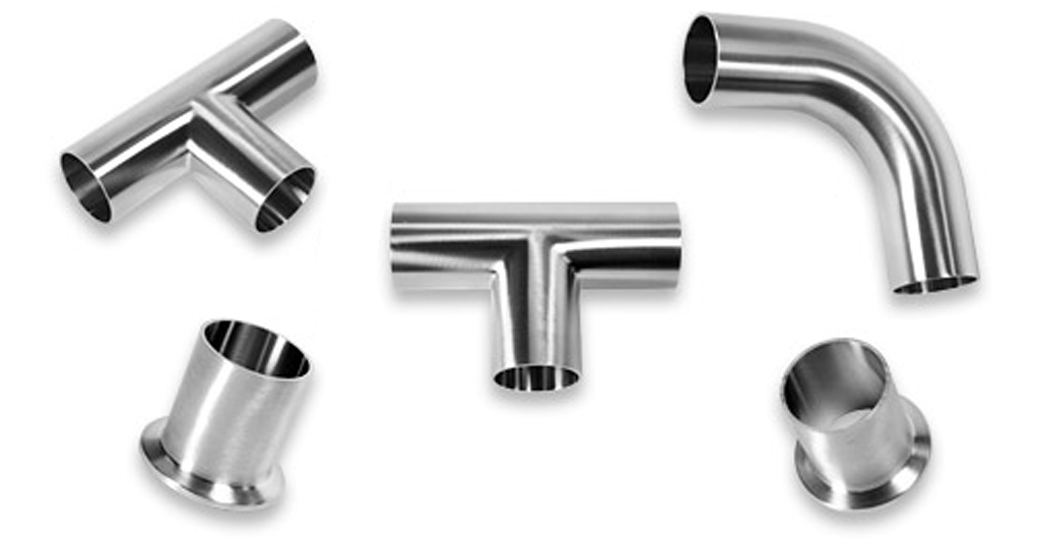
For product-contact surfaces, many teams prefer electropolishing — especially with 316L stainless steel — because it enhances hygienic design and cleanability. Electropolishing is an advanced finishing process that helps create a more uniform, low-roughness surface compared with mechanically polished finishes.

In practice, this matters for BPE fittings used in regulated environments where teams need repeatable sanitation results. When electropolished 316L BPE fittings are paired with ASME BPE expectations, the goal is to support low contamination risk by improving how the surface responds to cleaning and reducing the likelihood of residue retention on internal wetted areas.

If you’re selecting fittings for food, beverage, dairy, biotech, or pharmaceutical service, electropolished product-contact surfaces are often chosen because they align with hygienic performance goals: easier cleaning, more consistent verification, and stronger confidence in contamination control over time.

While both 304 and 316 stainless steels are versatile materials, the main differences lie in their chemical compositions, corrosion resistance in specific environments and cost. Contact the Steel & O’Brien team at sales@steelobrien.com to discuss the specific requirements of your application.

Monthly Archives
Recent Posts
  • Comparing Data Center Cooling Systems for AI Workloads July 29, 2026
  • How to Choose the Right Sanitary Valve (Without Overengineering It) July 15, 2026
  • Sanitary Stainless Steel Fittings vs. Standard Fittings: What’s the Difference? June 19, 2026
  • Exploring Data Center Cooling Trends May 8, 2026
  • What is Direct-to-Chip Cooling for Data Centers? November 21, 2025
  • Products
  • Custom
  • Services
  • Resources
  • Markets
  • About
  • Careers
  • Contact
  • US

An FCH company
Explore other FCH companies
  • Ace Sanitary®
    • Single-Use Tube Assemblies
    • Single-Use Silicone Tubing
    • Multi-Use Sanitary Hose
  • Flowtrend®
    • Sanitary Replacement Parts
    • Sanitary Valves
    • Sanitary Pumps
  • Strahman Group®
    • Sanitary Washdown
    • Process Valves
    • Valve Automation

Copyright ©2026. Steel & O’Brien Manufacturing. All rights reserved.

  • SMS Privacy Policy
  • Privacy Policy
  • Cookie Policy
  • Terms of Use
  • Site Map
  • Site by Straight North