

When Off-the-Shelf Doesn’t Work: Why Custom Sanitary Fabrication Matters
Standard sanitary components are the right solution for many processing systems. But not every processing system is standard.
Space constraints, unique equipment layouts, system expansions, and process-specific requirements can make it difficult to achieve the right result with catalog components alone. When standard fittings require excessive adapters, complicated routing, or field modifications, custom sanitary fabrication can provide a more effective solution.
Quick Answer: When Should You Use Custom Sanitary Fabrication?
Custom sanitary fabrication is the right option when standard sanitary components, sanitary fittings, or fabricated assemblies cannot efficiently meet a system's physical, process, installation, or hygienic requirements.
It can be especially valuable when you need to:
Fit a component into a confined or unusual space
Modify or expand an existing sanitary processing system
Create a specific offset, angle, or connection arrangement
Reduce unnecessary sanitary fittings and connections
Simplify a process flow path
Address drainage, dead-leg, or cleanability considerations
Replace an obsolete or unavailable stainless steel component
Build a custom component around specific equipment requirements
The goal is not to customize every part. The goal is to use a custom sanitary solution when standard components create more work than they solve.
The Limits of Off-the-Shelf Sanitary Components
Catalog components are designed for common applications—not necessarily your exact system.
Standard sanitary fittings, including elbows, tees, reducers, tubing, ferrules, and Tri Clamp connections, make repeatable sanitary process systems easier to build. Common process-piping components also include sanitary valves, which control, divert, or isolate product flow. When the dimensions and layout align with these standard options, they are often the best choice. But problems arise when they do not.
A facility expansion may need to connect new equipment to an existing process line. A replacement part may need to match legacy dimensions. A tight production area may require a custom offset or transition that standard fittings cannot achieve efficiently.
The result is often a workaround: multiple fittings to create the required geometry, longer flow paths, field modifications, unnecessary connections, or an assembly that is more difficult to install and maintain.
Custom sanitary fabrication allows the component to be designed around the system rather than forcing the system to work around the component.
When Is Custom Sanitary Fabrication the Better Option?
You're Modifying or Expanding an Existing System
Existing facilities rarely provide a blank slate. New equipment often has to connect to existing piping, sanitary valves, vessels, or process equipment with fixed locations and established connection points.
Standard components may technically make the connection possible, but the final assembly can become unnecessarily complicated.
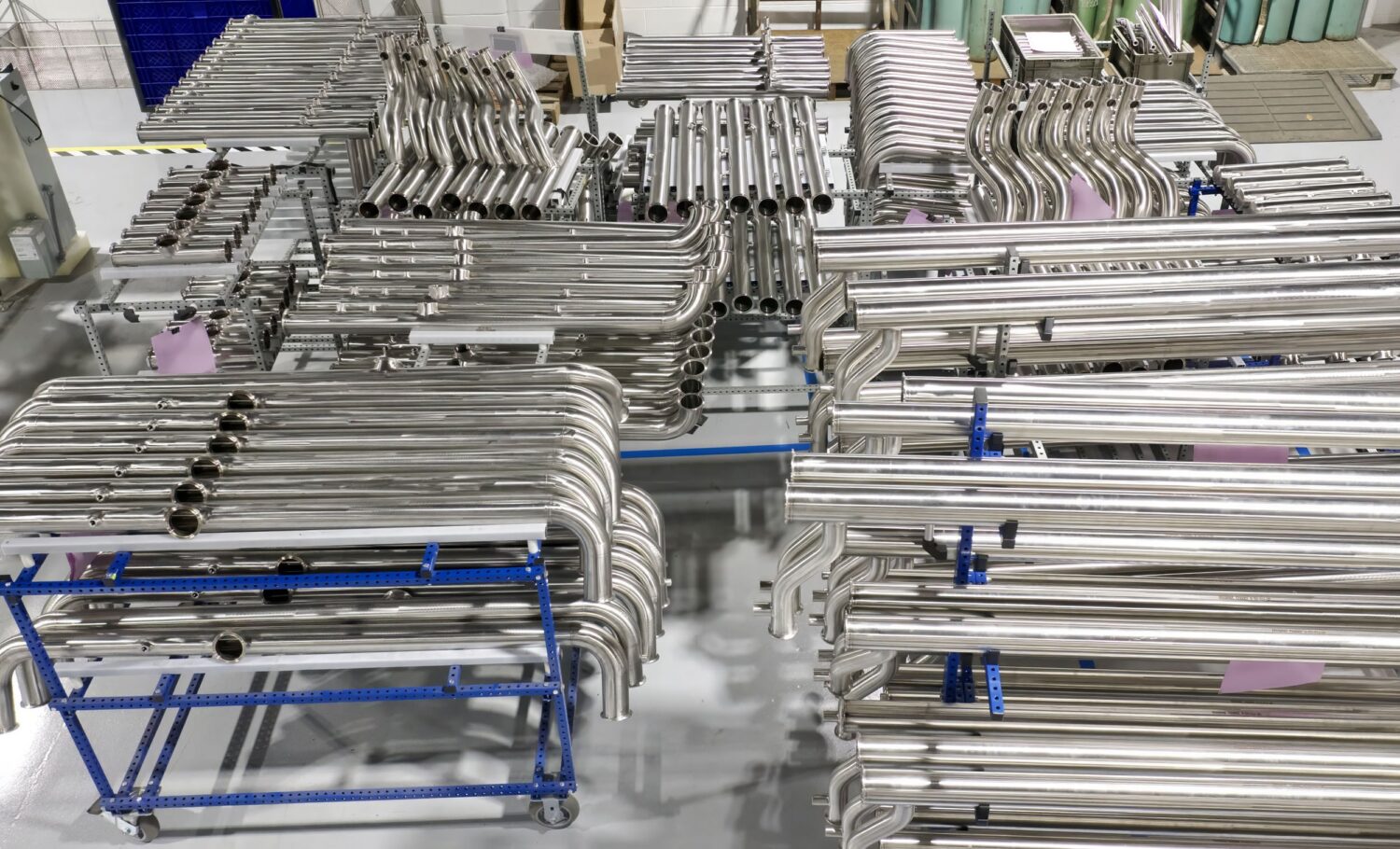
A custom fabricated spool, manifold, transition, or stainless steel tubing assembly can be designed around the exact dimensions and constraints of the existing system. This can be particularly useful for:
Equipment upgrades
Capacity expansions
Line reconfigurations
Facility renovations
Retrofit projects
Obsolete component replacement
Standard Parts Don't Fit the Available Space
Processing facilities often contain equipment and infrastructure installed over many years. New piping may need to work around existing process lines, structural elements, platforms, utilities, and equipment.
A standard component may work on a drawing but create clearance or installation problems in the actual facility.
Custom stainless steel fabrication can account for exact dimensions, required offsets, equipment connection locations, clearance requirements, installation access, maintenance access, and existing piping geometry.
The result is a component designed for the available space without adding unnecessary sections or connections.
You Need to Simplify the Flow Path
Sometimes multiple standard components are required simply to create a specific orientation or transition.
A custom fabricated component may achieve the same objective with a simpler assembly and more direct flow path. Depending on the application, this can help reduce:
Unnecessary directional changes
Excessive connection points
Complex routing
Avoidable flow restrictions
Potential hold-up areas
Custom fabrication is not automatically better. The right design depends on the product, process conditions, cleaning method, and system requirements. It becomes valuable when it solves a specific design problem more effectively than a standard assembly.
Cleanability Is a Critical Requirement
In sanitary processing, a component must do more than fit physically.
System geometry can affect product flow, drainage, cleaning, and maintenance. Unnecessary complexity can create areas that are more difficult to clean or inspect.
A properly designed custom sanitary component can help simplify the process path by reducing unnecessary connections and improvised assemblies. Depending on the application, it may support smoother flow paths, improved drainage, reduced dead-leg potential, CIP or SIP requirements, and easier maintenance access.
For food and beverage processing, custom sanitary fabrication should align with applicable 3-A Sanitary Standards and hygienic stainless steel piping practices. The design should support an appropriate surface finish, effective drainage, cleanable connections, and CIP or SIP requirements while minimizing areas where product residue or contamination could collect. Final requirements should always be confirmed against the applicable process specifications, sanitary standards, and facility procedures.
The required sanitary standards depend on the industry and process. Food and beverage, dairy, brewing, cosmetics, and personal care facilities commonly use hygienic stainless steel piping designed to limit contamination and support effective cleaning. Biopharmaceutical, pharmaceutical, biotechnology, and other high purity applications may require tighter controls for materials, welds, surface finish, documentation, and system qualification. Sanitary fittings and sanitary valves should be selected according to the applicable process specifications and standards, which may include 3-A Sanitary Standards, FDA requirements, EHEDG guidance, or ASME BPE. ASME BPE is especially relevant to biopharmaceutical and high-purity process piping because it addresses materials, dimensions, surface requirements, fabrication, inspection, and documentation. The appropriate standard depends on the product, cleaning method, regulatory environment, and facility requirements; it should be confirmed before fabrication begins.
What Does Custom Sanitary Fabrication Solve?
Custom fabrication is about more than getting a part that fits.
A well-designed custom stainless steel component can improve system layout, simplify installation, reduce unnecessary connections, and support long-term maintainability.
A component manufactured to the required dimensions may reduce the need for multiple adapters, field modifications, and last-minute installation changes. This can be especially valuable during planned shutdowns when time is limited.
Custom design can also account for equipment access, service clearance, and future maintenance requirements from the beginning.
Custom Doesn't Always Mean Starting From Scratch
Custom fabrication does not necessarily mean designing an entirely new product. Often, custom sanitary fabrication services use proven sanitary components and manufacturing capabilities to create the required combination of:
Lengths and dimensions
Angles and offsets
Connection types
Stainless steel material specifications
Surface finish requirements
Assembly configurations
The process can begin with a sketch, drawing, dimensions, photo, sample part, or description of the installation challenge. The best custom sanitary solution is usually the simplest one that solves the actual problem.
Speed Matters More Than People Think
Lead time is a common concern with custom work. Standard components are generally the fastest option when they directly meet the application's requirements. But forcing standard parts into a system when they do not solve the problem can create delays through additional orders, revised assemblies, field modifications, and installation rework.
With the right custom sanitary fabrication partner, moving efficiently from a defined requirement to a finished component can be more effective than repeatedly trying to solve a non-standard problem with standard parts.
Clear communication about dimensional, material, process, and sanitary requirements helps keep the project moving.
What Do You Need for a Custom Fabrication Project?
A sketch is often enough to start the conversation. To define the right custom sanitary fabrication solution, provide as much information as possible about:
Dimensions and layout: Lengths, connection locations, offsets, angles, and available space
Connection requirements: The sanitary fittings, tubing, valves, or equipment the component must connect to. For high-purity systems, also identify the required material grade, surface finish, weld quality, and documentation. 316L stainless steel is a common choice because of its corrosion resistance and suitability for hygienic processing, but the best material depends on the product, cleaning chemicals, temperature, pressure, and applicable standards. Confirm the final material and surface requirements before fabrication. When a custom assembly includes valves, choose the valve type based on its function, product characteristics, cleaning method, pressure, temperature, and required flow control. A sanitary ball valve is commonly used for straightforward shutoff or isolation, while other sanitary valves may be better suited for throttling, diverting flow, or handling specialized process requirements. The right selection should be confirmed with the process engineer and applicable sanitary specifications before fabrication.
Material requirements: Stainless steel grade and applicable material documentation or traceability requirements
Process requirements: Product, temperature, pressure, flow, and cleaning considerations
Sanitary requirements: Required surface finish, CIP or SIP compatibility, drainage considerations, and applicable specifications. Surface finish requirements depend on the product, cleaning method, contamination risk, and industry standards. Hygienic applications may require a smooth, polished stainless steel surface, while high-purity systems can require tighter roughness limits, electropolishing, weld-finish controls, and supporting documentation. Confirm the required finish and acceptance criteria with the applicable sanitary specification before fabrication.
The more clearly the requirements are defined upfront, the more efficiently a custom stainless steel component can be designed and manufactured around the application.
Frequently Asked Questions About Custom Sanitary Fabrication
What is custom sanitary fabrication?
Custom sanitary fabrication is the design and manufacture of stainless steel components or assemblies built to meet specific dimensional, process, material, or sanitary requirements that cannot be efficiently addressed with standard catalog parts.
When should I choose custom fabrication instead of standard sanitary fittings?
Consider custom fabrication when standard sanitary fittings do not fit the available space, require excessive adapters or connections, cannot provide the required geometry, or create unnecessary installation and maintenance challenges.
Can custom sanitary fabrication help improve cleanability?
It can. A properly designed custom sanitary component may simplify flow paths, reduce unnecessary connections, and address drainage or dead-leg considerations. The appropriate design depends on the complete process and applicable sanitary requirements.
How are sanitary spools inspected and tested before shipment?
Inspection and testing for a sanitary spool depend on the project specifications, process requirements, and applicable standards. Before shipment, a fabricator may verify dimensions, connection locations, material requirements, weld quality, surface finish, cleanliness, and overall assembly condition. Required documentation may include material certifications, inspection records, weld documentation, or test results when specified by the project.
A pipe spool may also be checked for fit-up against drawings or approved dimensions. Pressure, leak, or other functional testing should be completed when required by the design and applicable specifications. Confirm the inspection scope, acceptance criteria, and documentation requirements with the fabricator before pipe spool fabrication begins to ensure the finished assembly is ready for installation.
When Standard Parts Create Workarounds, Consider Custom
Standard sanitary components are essential for efficient, repeatable system design. When they fit the application, there is no reason to overcomplicate the solution.
But when unique dimensions, space constraints, existing equipment, or process requirements create a problem that catalog parts cannot efficiently solve, custom sanitary fabrication provides another option.
The right custom component can simplify installation, reduce unnecessary connections, improve system layout, and support the specific requirements of the application.
Custom isn't always necessary. But when you're forcing standard parts into a non-standard system, a purpose-built sanitary solution can make a measurable difference.
Have a Unique Process Challenge?
When standard sanitary components don't fit the space, process, or system requirements, Steel & O’Brien can help. Send Steel & O’Brien your sketch, drawing, dimensions, or sample part. Our team can help evaluate your requirements and develop a custom sanitary fabrication solution designed around your system.